
We Vacation in Walkable Places… Then Pave Our Own
- Kayla Copeland

- Jun 2
- 7 min read
Poured by: Kayla Copeland, PLA
The other day I was doing the usual “I’ll just check Facebook for two seconds” thing when this post stopped my thumb completely.
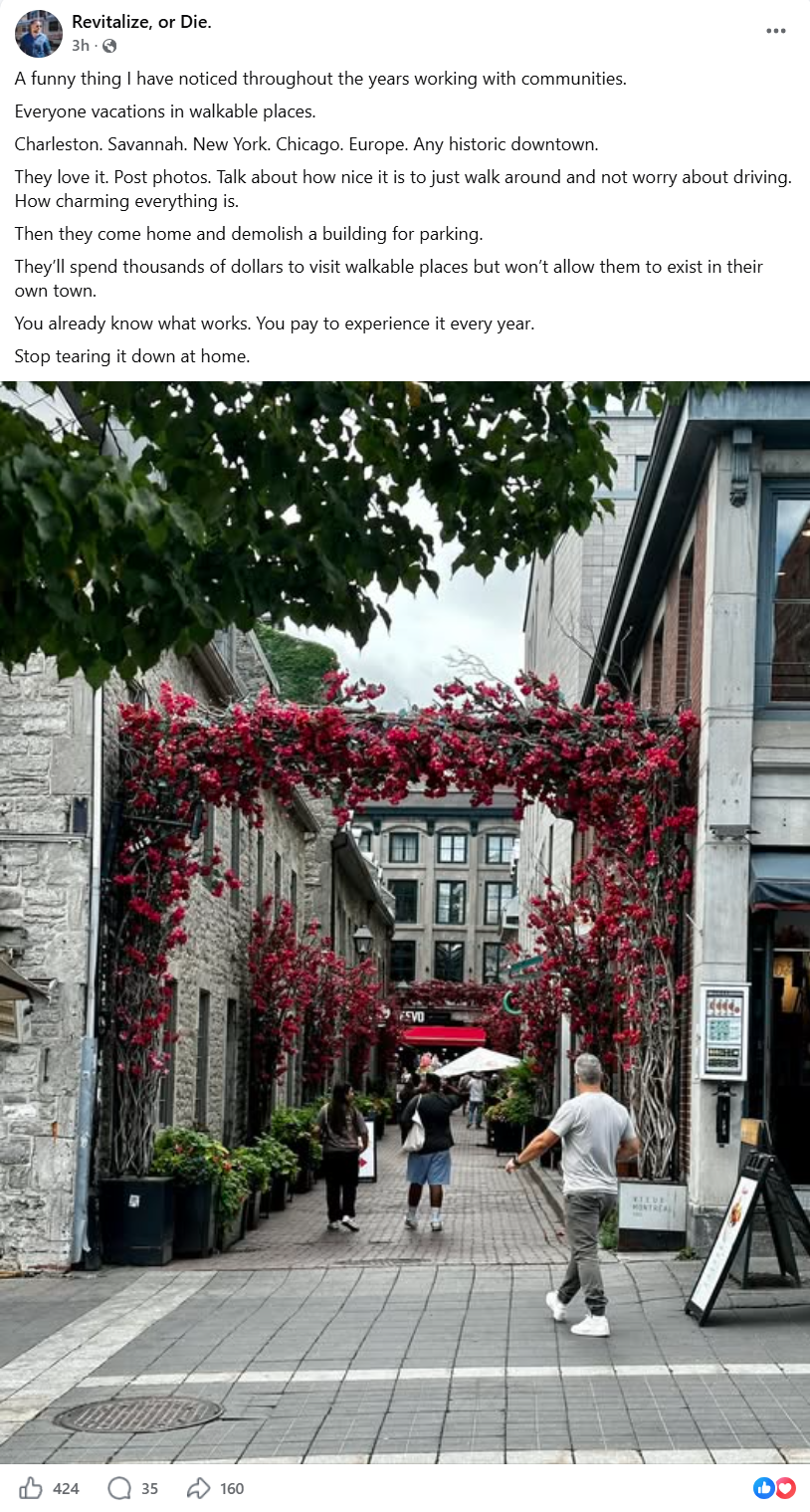
“Everyone vacations in walkable places…They love it. Post photos. Talk about how nice it is to just walk around and not worry about driving. Then they come home and demolish a building for parking…You already know what works. You pay to experience it every year. Stop tearing it down at home.”
Ouch. And also: yes!!!
It was paired with a photo of a narrow street lined with old stone buildings, draped in flowers, and full of people on foot instead of cars. The exact kind of place we all swoon over on vacation. The kind of place we describe later as “so charming” and “just so easy to walk around,” while we scroll through photos and think, why can’t it feel like this at home?
And that post basically said: you love this. You pay for this. Please stop voting, zoning, and spending against this where you actually live.
Vacation Brain vs. Home Brain
Think about your last favorite trip…
You probably didn’t come home raving about how efficient the six‑lane arterial was or how expansive the surface parking felt. You remember wandering down a shaded street where you could drift from café to shop to park without touching your car keys. You remember turning a random corner and finding a tiny square with a fountain, kids playing, and someone playing guitar on the street corner. You remember what it felt like to walk at your own pace instead of constantly timing gaps in traffic or worrying about which turn to make.
When we’re away from home, we instantly recognize the value of narrow, people‑scaled streets, generous sidewalks with trees, little plazas and pocket parks, and the ability to move mostly on foot with driving as the exception, not the rule or how we survive. It just feels human.
But when we get home? Home brain kicks in. We say things like, “We really need more parking downtown.” “Gosh, I wish we didn’t have to walk this far.” “No one walks here anyway.” We forget that the places we just paid good money to visit are often the ones that didn’t tear down their buildings for parking. They kept their urban fabric intact and made walking pleasant, safe, and interesting… and then we flew there to enjoy it!
Jeff Speck: Four Simple Words, and One Big Wake‑up Call

Jeff Speck talks about this so clearly in his TED Talk, “4 Ways to Make a City More Walkable.” He makes walkability sound less like magic and more like a checklist: is walking useful, safe, comfortable, and interesting? Useful means you can actually get to daily needs on foot. In our world of landscape architecture and planning we like to refer to this as connectivity (connecting one place to another). Safe means you’re not playing “dodge the SUV” at every crossing. Comfortable means the space feels human‑scaled and shaded, not like the shoulder of a highway. Interesting means there’s something to look at along the way besides blank walls and the backs of parking lots. This could be outdoor café’s to people watch or public art along street edges.
The first time I watched his talk, I found myself nodding so hard my neck hurt. That Facebook post is basically Jeff Speck’s whole TED Talk condensed into one spicy paragraph: we know what works because our vacation photos are the receipts.
Oklahoma City even gets a shout‑out in his TED Talk. In it, Speck explains how Prevention magazine once named OKC the worst city in the entire country for pedestrians…which, honestly, is not the trophy anybody wants to put on the mantle. That wake‑up call, paired with a new Devon Energy tower and a big pot of TIF dollars, helped kick off Project 180: a $180‑million effort to rebuild roughly 50 blocks of downtown streets. Lanes were narrowed, many one‑way “mini freeways” were converted back to two‑way, on‑street parking was doubled, bike facilities were added, and more than 2,500 street trees went into shade sidewalks and cool pavement. I was lucky enough to get to be part of the design and implementation for Project 180 during my very first job out of school – at HFSD! I am very proud to be apart of this legacy and turning point for Oklahoma City.
Ten years later, downtown feels completely different. Instead of racing through a hot, over‑scaled grid, people actually walk, linger, shop, and dine. New stores and restaurants have opened, tourism has grown, and local leaders credit Project 180 with helping bring downtown Oklahoma City back to life—socially, economically, and yes, aesthetically. It was our city saying, “Okay, we can do better than this,” and then actually proving it on the ground. The livelihood, walkability, and energy in downtown Oklahoma City is the exact reason I prioritized placing my own landscape architecture firm in the heart of the beat! Our office is located on Main Steet in the West Village district of downtown Oklahoma City. We walk to lunch, explore mid-day journeys through the Myriad Garden and Scissortail Park, and take fun happy hours at our local favorite bar in our building – Bar Arbolada! Life is sweet and alive in downtown Oklahoma City!
How Trips Look Through a Landscape Architect’s Eyes
When I travel, my landscape‑architect brain does not take a day off. I’m the person walking down a beautiful street saying, “Look at those trees,” while everyone else is looking at the gelato. Now, don’t get me wrong…I also partake in the gelato, but I encourage the delight be taken up under the trees too!


I notice the rhythm of street trees and how one missing tree can make a whole block suddenly feel harsh and exposed. I notice whether a sidewalk is generous enough for strollers, side‑by‑side walking, and kids zig‑zagging on scooters (totally my kids – sorry if you’ve been bumped by one of them), or if it’s more of a “single file and hope for the best” situation. I notice how a tiny park with three benches and some planting can become the neighborhood’s living room, full of people who clearly did not plan ahead to be together but somehow are. Picnicking in the shade of a large tree or playing fetch with their dog.
And I think about the little things: the curb extension that shortens a crossing so a parent with two kids and an overstuffed beach bag doesn’t have to sprint; the median with trees and a narrow lane that slows cars without 14 signs yelling “SLOW”; the side path along a busy road that transforms “I would never walk there” into “let’s just walk, it’s nice.”

None of that happens by accident. Someone sketched it, argued for it in a meeting, found the funding, and watched it get built in the real world. This is the landscape architects dream, passion, and goal – to develop, design, and create beautiful, connective, thriving outdoor spaces.
Bringing Vacation Energy Home
So that Facebook post asks a really uncomfortable question: if we love walkable places so much when we’re on vacation, why don’t we champion them at home?
As a landscape architect working in Oklahoma, I don’t get to redesign entire cities (though if anyone wants to hand me the keys, I have ideas). But our team does get to shape little pieces of the puzzle.
Sometimes that looks like a park that’s actually connected to the neighborhood by a comfortable sidewalk or trail, not just a parking lot and a hope. Sometimes it’s a downtown streetscape where trees, lighting, and furnishings make it feel like a place to stroll and stay, not just drive through. It might be a median or gateway that quietly says, “You’re in a place that matters now, slow down and look around.” Or a trailhead that feels safe and welcoming enough that families think, “Let’s walk or bike,” instead of automatically piling into the car.
On a plan set, those might be just a few lines and symbols. In real life, they’re the difference between a place you hurry through and a place you remember.
What This Means for Our Communities
For our Oklahoma towns and cities, embracing walkability doesn’t have to mean importing some perfect European postcard. It can mean choosing to save existing buildings and fill in gaps instead of clearing more land for parking. It can mean investing in tree‑lined sidewalks on routes people already use: between schools and neighborhoods, between parks and main streets. It can mean calming traffic in key areas so crossing the street doesn’t feel like an extreme sport, and designing parks, plazas, and trail connections that make it easier and more enjoyable to walk, linger, and gather.
Every time a community says yes to those kinds of projects, they’re quietly saying, “We want the kind of place people love to visit, even when they live here.”
A LATTE-Sized Invitation
So here’s my little LATTE challenge for you.
Next time you’re on a trip and you catch yourself thinking, “I love it here,” pause for a second and do a quick mental sketch. What about this street or square makes it feel so good to walk in? How wide are the lanes? Where are the trees and benches? How close are shops, parks, and housing to each other? How many times did you cross a street without feeling your shoulders tense?
Then, when you come home, don’t leave those observations stuck in your camera roll. Mention them at a public meeting. Send a note to your city councilor. Support the projects that add trees, narrow crossings, and protect existing buildings instead of demolishing them. Ask, “Would I pay to visit a place like this? If yes…why aren’t we building more of it here?”
As for me, I’ll be here with my team sketching and designing our way through parks, streetscapes, and trails trying to sneak a little “favorite vacation street” energy into the everyday routes of our Oklahoma communities.


Thanks for sharing this LATTE break with me, here’s to fewer parking‑lot memories, more walkable streets, and hometowns that feel just as lovable as the places we fly to see.


Comments