
Blackberry Dreams: Growing Thornless Blackberries (and Turning Them Into Pie Bars)
- Kayla Copeland
- 7 days ago
- 5 min read
Poured by: Kayla Copeland, PLA
In early March, I planted what I’m calling my dream hedge of blackberry plants. Some people have vision boards; I have a backyard that doubles as a plant laboratory. Sometimes my family gets to reap major rewards of flavor and beauty, and sometimes my experiments mega fail. I’m oddly okay with that, because I want to learn. I want to have real‑life experience with the plants I recommend to clients. I want to know how they grow, how they sulk, how they behave through the seasons, and what it actually takes to keep them happy…so I can design with confidence and give lived‑in guidance, not just pretty drawings.
In this LATTE, I’ll share why I chose two specific thornless varieties (Apache and Arapaho) for our personal family Oklahoma garden, plus the blackberry pie bars my daughter and I baked to celebrate planting them – yum yum!

Blackberries have always been a nostalgic plant I’ve wanted for my little micro‑homestead. I grew up with so many memories of picking blackberries in my Granny and Paapaa’s field in Houston. They grew rows and rows of blackberries, grapes, apples, pears, figs, pecans, and more. As a kid, we’d spend hours filling buckets picking berries. Half of the berries went straight into our mouths, obviously. The rest became cobblers, cakes, jams, marinades, and even wine (I never got a taste as a child, but I remember the glass jars all over the pool table room). I just loved it, and I’ve always wanted to recreate some of those sticky, sun‑soaked memories with my own family.
I also remember coming back from picking with scratches all over my arms, so for my garden I’m sticking with thornless blackberries. It’s a simple, happy upgrade that keeps all the nostalgia and loses the battle wounds (quick shout out to the brilliant horticulturists out there developing these thornless varieties – you’re the real MVP).
Why I Chose Apache and Arapaho
At home, I planted two varieties: Apache and Arapaho. The OSU Extension is one of my favorite go‑tos when I’m researching garden plants. They’ve got solid info on which cultivars work here, how to plant them, when to prune, how to fertilize…basically the “blackberry planting for dummies” guide. If you’re thinking about starting or expanding a garden in Oklahoma, their resources are absolutely worth a rabbit hole or two. Also, Oklahoma State University is my alma mater, so go POKES!
From a design and maintenance standpoint, here’s why these two rise to the top for an Oklahoma garden.
Apache Blackberry (Thornless, Big, and Bold)
Apache blackberries are a great fit for an Oklahoma home garden thanks to their thornless canes, big berries, and strong performance in heat. They’re like the “go big or go home” friend of the berry world.
Thornless, erect canes developed by the University of Arkansas
Large, glossy, sweet‑tart berries that ripen from mid‑summer into early fall
Typically 5–8 feet tall and 4–8 feet wide at maturity
Often stand without a heavy trellis, though a simple wire or two helps once the fruit load gets heavy
Do best with consistent moisture and 3–6 feet between plants for airflow
Designer note: I like Apache when you want a taller, “berry hedge” backdrop like along a fence, property line, or to frame a garden path. I’m planting mine along the fence line of my micro‑homestead so one day it feels like a green, fruiting wall.
Arapaho Blackberry (Early, Sweet, and Manageable)
Arapaho blackberries bring fruit a bit earlier in the season and stay a little more compact, which makes them perfect for smaller spaces or mixed edible borders. Think “tidy overachiever” to Apache’s “tall, dramatic cousin.”
Thornless, erect canes that usually grow 4–6 feet tall and 3–4 feet wide
One of the earliest‑ripening thornless varieties, often starting in June
Medium to large, firm, sweet berries with very small seeds
Lower chilling requirement, so they fruit reliably even after mild winters
Prefer full sun, well‑drained, slightly acidic soil, and 3–4 feet between plants
Designer note: I reach for Arapaho when someone wants an earlier harvest and a neater, easier‑to‑manage footprint near patios, walkways, or play areas. It’s also a great choice for picky eaters because the seeds are smaller and less noticeable. Translation: fewer complaints, more berries eaten. It would be a fantastic choice for a community or elementary school garden.
Evelyn’s Pruning Secret
One of the simplest tricks for keeping blackberry plants productive comes from Evelyn in our office, who is basically our resident blackberry whisperer. She says to chalk‑mark your canes during the growing season…simple and brilliant!
Blackberries only fruit on two‑year‑old canes. That means the canes that produced berries this summer need to be removed in winter, while the fresh new canes must stay to fruit next year. The problem? Once the leaves drop, all the canes decide to put on the same outfit and look exactly alike.
That’s where chalk paint comes in.
By brushing a quick stripe of chalk paint on the new primocanes as they grow, you create an easy visual guide for winter pruning. When the cold months arrive, the system is simple…the painted canes stay, unpainted canes go. It prevents accidental over‑pruning, speeds up your winter cleanup, and keeps your berry patch organized and productive. This method is especially handy for thornless varieties like Apache and Arapaho, where you can’t rely on thorns or cane texture to tell the difference.
A few seconds of marking in the summer saves a lot of guesswork in winter, and sets you up for a bigger, healthier harvest next season. I’ll definitely be taking her advice and testing this maintenance method on my berries this summer.
A Living Hedge and a Little Patience
We planted the blackberries, and now I get the fun part…watching, tending, and learning for the next couple of years. Blackberries produce on two‑year‑old canes, so I’m expecting our first real harvest the summer after planting. In the meantime, I’ll be watching how they handle Oklahoma wind, late freezes, and our special brand of summer heat…filed under “research” and “hopeful anticipation.”
I love that this little hedge is both a design experiment and a future dessert bar.
Blackberry Pie Bars with Everly

To celebrate planting our blackberries, and imagining those juicy berries in our mouths, my daughter Everly and I made blackberry pie bars. I let my four‑year‑old pick out our pan, and of course she chose the heart. (Honestly, I respect the commitment to the love of berries theme.)
Here is our recipe for fun. I hope you can enjoy it with your family, whether your berries are store‑bought, from the farmers market, or straight from your own backyard.
Blackberry Pie Bars

Ingredients
Crust and Topping
1 cup all‑purpose flour
½ cup granulated sugar
½ cup unsalted butter (cold), cut into cubes
1 large egg
1 teaspoon baking powder
1 pinch salt
Filling
2 cups fresh blackberries
½ cup brown sugar
(Optional) 1 teaspoon Palisade Peach Spice from Savory Spice (a local OKC spice shop I love for all my “secret ingredient” moments)
Instructions
Preheat oven to 350°F and line an 8×8‑inch baking pan (or in our case, the heart pan) with parchment paper or a light coat of PAM spray.
In a bowl, mix flour, granulated sugar, baking powder, and salt. Cut in the cold butter until the mixture resembles coarse crumbs. Add the egg and mix until fully combined.
Press two‑thirds of the mixture firmly into the bottom of the prepared pan to form the crust.
In a separate bowl, toss blackberries with brown sugar (and spice mix, if using). Spread the berry mixture evenly over the crust.
Crumble the remaining crust mixture on top of the blackberries.
Bake for 40–45 minutes, or until golden brown and bubbly at the edges. Let cool before slicing into bars and sharing with your favorite people.


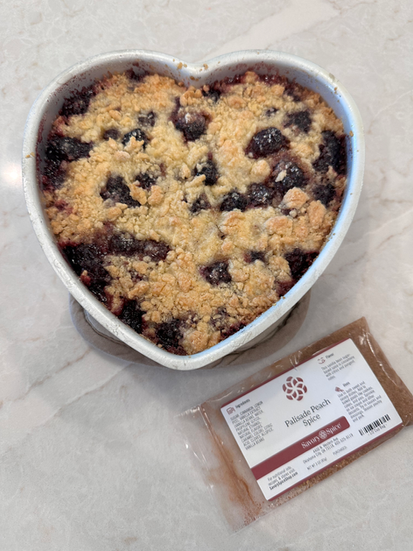
Thanks for sharing this LATTE break with me—here’s to full produce baskets, sticky fingers, and yummy berries (in two-ish years) 😊.
